

.webp)
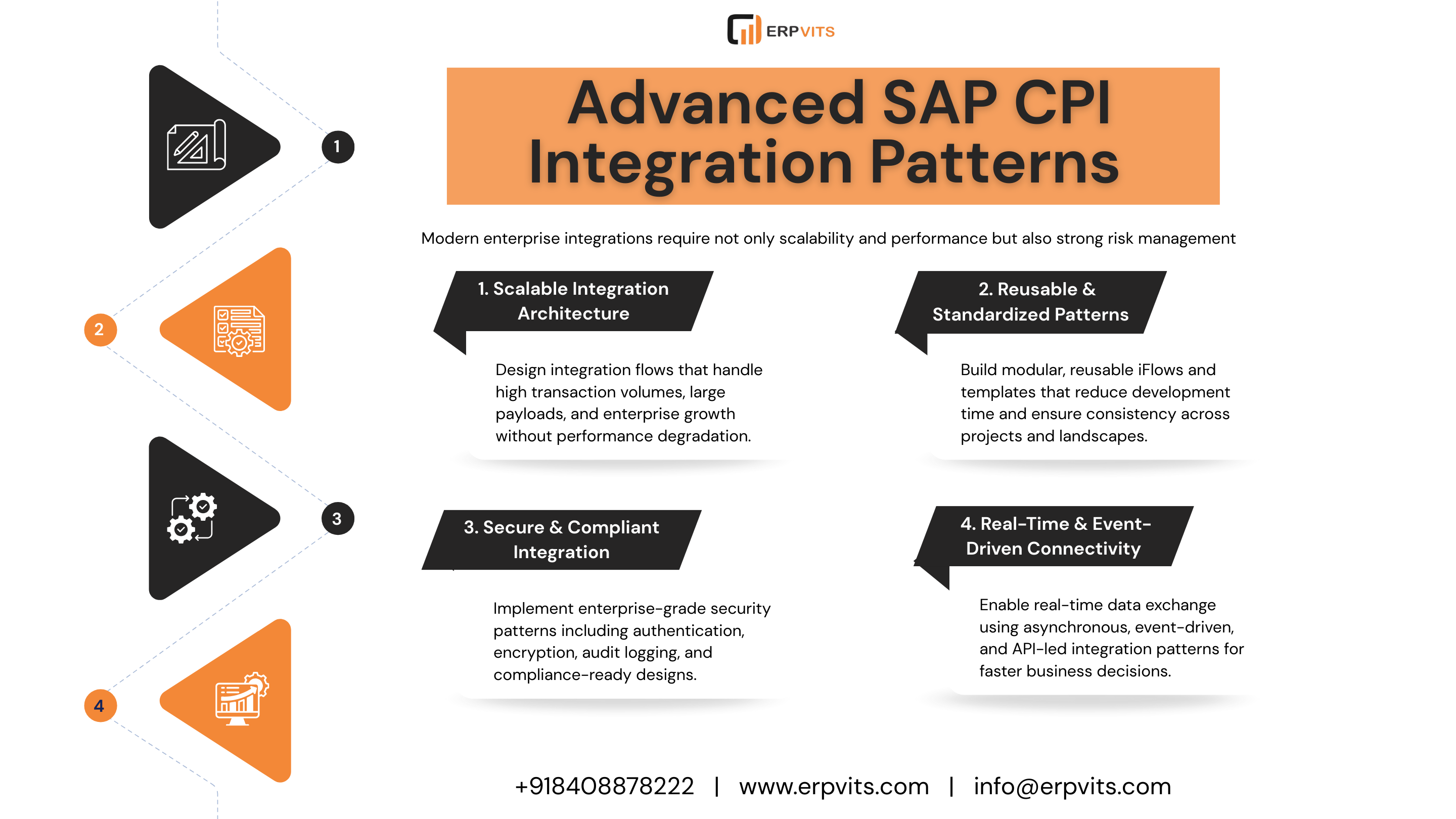
Advanced SAP CPI Integration Patterns for Enterprise-Scale Cloud Landscapes
Modern enterprises operate in increasingly complex digital ecosystems, where applications, databases, and services must communicate seamlessly between cloud and on-premises environments. This comprehensive guide explores advanced SAP Cloud Platform Integration (SAP CPI) patterns specifically designed for enterprise-scale deployments. We examine sophisticated integration architectures that go beyond basic connectivity, exploring proven patterns for message routing, transformation, orchestration, and error handling that support thousands of concurrent transactions.
Whether you're managing a multinational corporation's integration landscape or architecting solutions for high-volume B2B scenarios, this guide provides the technical depth and strategic insights needed to build robust, scalable integration architectures. Discover how leading organizations leverage SAP CPI advanced patterns to create maintainable, flexible integration frameworks that drive business agility while ensuring security, compliance, and performance at scale. SAP CPI Online Training programs often focus on these advanced patterns that professionals need to master enterprise integration.
Understanding SAP CPI Integration Patterns in Enterprise Cloud Environments
Integration patterns are reusable, proven solutions to common integration challenges encountered when connecting disparate systems within an enterprise. In SAP CPI, these patterns represent best practices for handling various integration scenarios, from simple data synchronization to complex process orchestrations spanning multiple systems.
Core Pattern Categories:
- Messaging Patterns: Publish-subscribe, request-reply, fire-and-forget, guaranteed delivery
- Routing Patterns: Content-based routing, recipient list, dynamic routing, message filtering
- Transformation Patterns: Message mapping, data normalization, enrichment, format conversion
- Orchestration Patterns: Sequential processing, parallel execution, aggregation, splitting
- Error Handling Patterns: Exception management, retry mechanisms, dead-letter queues, compensation logic
- Security Patterns: Authentication, authorization, encryption, digital signatures
Key Differentiators:
- How SAP CPI patterns differ from traditional point-to-point integrations
- The role of patterns in maintaining enterprise architectures
- Selecting the appropriate pattern for specific use cases
- Avoiding common integration pitfalls through proven approaches
- Adapting patterns to evolving business requirements
Why SAP CPI Integration Patterns Are Critical for Large-Scale Organizations
For large-scale organizations, SAP CPI integration architecture decisions carry significant implications. Well-designed, properly implemented patterns provide the foundation for digital transformation, while poor designs can create problems that cascade across business processes.
Strategic Benefits:
- Cost Efficiency: Reduced total cost of ownership through reusability and standardization
- Accelerated Delivery: Faster time-to-market through proven approaches
- Enhanced Reliability: Increased system stability through battle-tested solutions
- Governance and Compliance: Built-in security and audit capabilities
- Scalability: Support for business growth without architectural rewrites
Operational Benefits:
- Handle high transaction volumes efficiently
- Maintain data consistency across distributed systems
- Implement robust error recovery mechanisms
- Support multi-region, multi-tenant deployments
- Enable both batch and real-time integration scenarios
Risk Mitigation:
- Avoid vendor lock-in and technical debt
- Minimize disruption during system upgrades or migrations
- Maintain flexibility to adapt to market changes
- Establish documented, repeatable processes
Advanced SAP CPI Integration Patterns for Real-Time Enterprise Scenarios
Key Application Patterns:
- Event-Driven Architecture: Implementing publish-subscribe patterns for real-time data distribution across SAP and non-SAP systems
- Asynchronous Processing: Utilizing JMS queues and guaranteed delivery mechanisms for critical business transactions
- Content-Based Routing: Dynamic message routing based on payload content, business rules, and system availability
- Parallel Processing: Concurrent execution of multiple integration flows to maximize throughput and minimize latency
- Error Compensation: Advanced rollback and compensation logic for maintaining data integrity across distributed transactions
- Circuit Breaker Pattern: Preventing cascade failures when downstream systems become unavailable
- API-Led Integration: Combining system APIs, process APIs, and experience APIs for flexible enterprise connectivity
Handling Large Payloads: SAP CPI Implementation Patterns
Managing large payloads in SAP CPI presents unique challenges requiring specialized integration strategies to maintain system stability and optimal performance. When dealing with files exceeding several megabytes or handling bulk data transfers containing thousands of records, conventional integration approaches often fail due to memory constraints, timeout limitations, and network bandwidth issues.
Effective large payload handling requires implementing specific patterns such as message splitting, which divides large datasets into manageable chunks that can be processed independently and reassembled as needed. Stream processing patterns enable continuous data flow without loading entire payloads into memory, significantly reducing resource consumption. Pagination patterns are critical for extracting large datasets from source systems, enabling controlled data retrieval in manageable portions.
Additionally, implementing asynchronous processing using queue-based architectures ensures that large payloads don't block other integration flows. SAP CPI Online Training programs comprehensively cover these large payload handling strategies for real-world enterprise scenarios.
Designing Reusable SAP CPI Integration Patterns for Real-World Projects
Creating reusable integration patterns in SAP CPI is fundamental to building sustainable, maintainable enterprise integration systems that evolve with business needs. Reusability begins with proper pattern abstraction—identifying common integration requirements across projects and designing generic solutions that can be parameterized for specific use cases.
This involves developing modular integration flows where components like authentication handlers, logging mechanisms, error processors, and transformation logic are constructed as reusable artifacts that can be imported into multiple iFlows. Template-based development accelerates project delivery by providing pre-configured integration flows for common scenarios such as employee synchronization between SAP S/4HANA and SuccessFactors or order-to-cash processes.
Configuration externalization through properties files and value mappings ensures that the same integration pattern can be deployed across development, testing, and production environments without code modifications. Establishing naming conventions, documentation standards, and a centralized pattern library creates organizational knowledge that accelerates onboarding of new team members and promotes consistency across projects. Learn SAP CPI reusability techniques to maximize development efficiency and project success.
Message Transformation and Routing with SAP CPI Integration Patterns
Dynamic Content-Based Routing:
- Route messages to different endpoints based on payload content, headers, or business logic
- Implement recipient list patterns for multi-destination message delivery
- Configure conditional routing using XPath, JSONPath, or Groovy script expressions
- Design filter patterns to prevent unnecessary message processing
- Utilize splitter patterns for distributing aggregated messages to multiple recipients
Message Transformation Strategies:
- Apply message mapping for structural conversion between source and target formats
- Implement data enrichment patterns by calling external services or databases
- Perform format conversion between XML, JSON, EDI, and proprietary formats
- Design normalization patterns for standardizing data from heterogeneous sources
- Utilize XSLT, Groovy, or JavaScript for complex transformation logic
Advanced Routing Techniques:
- Configure load balancing across multiple backend systems
- Implement failover routing for high-availability scenarios
- Design versioning patterns supporting multiple API versions simultaneously
- Apply rate-limiting and throttling for controlled message flow
Error Handling and Exception Management in SAP CPI Integration Patterns
Robust error handling is the cornerstone of enterprise-grade SAP CPI integration solutions, yet it's often neglected until production issues arise. Effective exception management in SAP CPI requires a multi-layered approach that anticipates failures at every integration point—from network connectivity issues and authentication failures to data validation errors and backend system unavailability.
Implementing proper error handling patterns begins with defining a clear exception hierarchy that categorizes errors into technical (system failures), functional (business rule violations), and transient (temporary connectivity issues). Each category requires different treatment: technical errors might trigger immediate alerts to operations teams, functional errors could be routed to business exception queues requiring manual resolution, and transient errors benefit from automated retry mechanisms with exponential backoff.
Dead-letter queues ensure failed messages aren't lost but rather captured for analysis and reprocessing. Compensation patterns are critical in scenarios involving multiple system updates, enabling partial rollbacks when downstream processes fail. Comprehensive logging and monitoring integration—using SAP Cloud ALM or third-party tools—provides visibility into error patterns and system health.
Alert escalation workflows ensure critical errors receive immediate attention while routine errors are batched for periodic review. A well-designed error handling strategy not only improves system reliability but also reduces operational costs by enabling automated recovery and providing actionable insights for continuous improvement.
Securing SAP CPI Integration Patterns for Enterprise Systems
Authentication and Authorization Patterns:
- OAuth 2.0: Secure API access and token management
- Certificate-based authentication: System-to-system communications
- SAML-based SSO: User-driven scenarios
- API key management: Rotation strategies and lifecycle management
- Role-based access control (RBAC): Controlling access to integration artifacts
Secure SAP CPI Integration Methodologies for Enterprise Systems
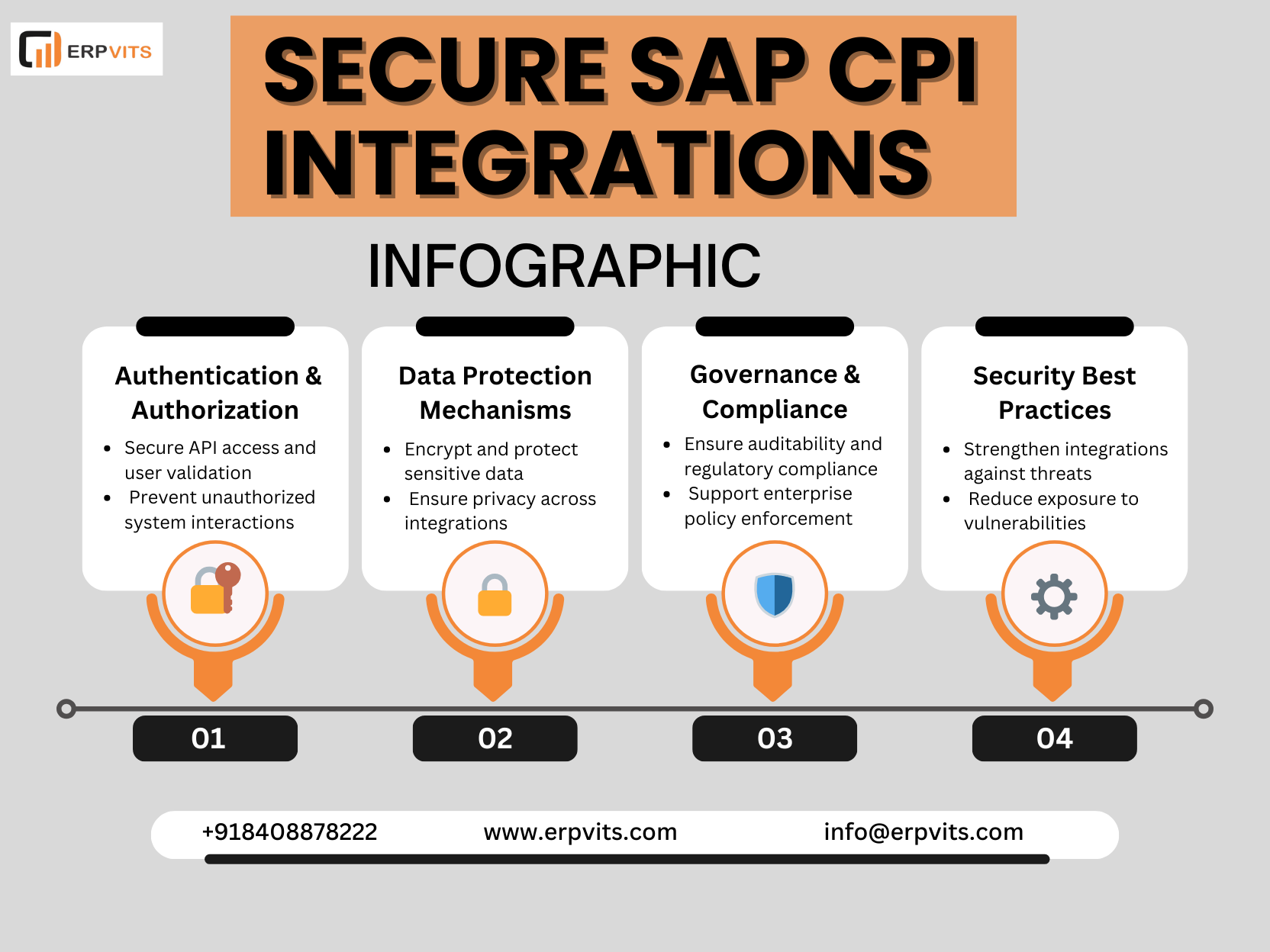
Patterns for Authorization and Authentication:
- OAuth 2.0: Ensuring secure access to APIs and comprehensive token management including token refresh, expiration handling, and scope-based access control
- Certificate-based Authentication: Utilizing X.509 certificates for secure system-to-system communications, enabling mutual TLS authentication for enhanced security
- SAML-based SSO: Supporting user-driven scenarios with Single Sign-On capabilities, enabling seamless authentication across multiple enterprise applications
- API Key Management: Implementing robust strategies for API key generation, rotation, and lifecycle management to prevent unauthorized access
- Role-Based Access Control (RBAC): Controlling access to integration artifacts through fine-grained permissions, ensuring users only access resources necessary for their roles
Implementing these authentication and authorization patterns creates a comprehensive security framework for SAP CPI integration landscapes. Organizations must layer these security mechanisms to establish defense-in-depth protection, ensuring that even if one security control fails, additional controls provide continued protection. Regular security audits, penetration testing, and compliance reviews ensure these patterns remain effective against evolving security threats.
Data Protection Strategies:
- End-to-end encryption: GPG/PGP for sensitive payloads
- SSL/TLS: Secure transport layer communications
- Data masking: Protecting personally identifiable information (PII)
- Tokenization: Credit card and financial data security
- Secure parameter storage: Using CPI security materials
Governance and Compliance:
- Audit trails: Tracking data access and modifications
- Digital signatures: Message integrity verification
- GDPR compliance: Data retention and deletion policies
- SOX compliance: Segregation of duties
- Encryption key lifecycle management: Rotation and policies
Security Best Practices:
- Defense-in-depth strategies across integration layers
- IP whitelisting and network-level access controls
- Secure credential storage avoiding hardcoded passwords
- Regular security assessments and vulnerability scanning
- Incident response plans for security breaches
API-Led SAP CPI Integration Patterns for Enterprise Systems
Systems API Layer:
- Direct connectivity to backend systems (SAP S/4HANA, SuccessFactors, third-party databases)
- Data extraction, transformation, and standardization from source systems
- Protocol mediation between SOAP, REST, OData, and RFC
- System-specific error handling and retry mechanisms
- Rate limiting and throttling for backend system protection
Process API Layer:
- Orchestration of multiple system APIs for complex business processes
- Implementation of business logic and validation rules
- Coordination of cross-system transactions and compensation patterns
- Data aggregation and enrichment from multiple sources
- Stateful process management for long-running workflows
Experience API Layer:
- Consumer-specific API endpoints tailored for mobile, web, or IoT applications
- Response formatting optimized for different client types
- API gateway patterns for security, caching, and analytics
- Version management for backward compatibility
- Developer portal integration for API documentation and testing
Transport Management and Version Control for SAP CPI Integration Patterns
Effective transport management and version control are critical yet often overlooked aspects of SAP CPI implementations that directly impact deployment reliability and operational stability. Implementing proper version control using Git repositories, structured branching strategies, and automated CI/CD pipelines using Jenkins, Azure DevOps, or SAP Cloud Transport Management reduces manual errors and accelerates release cycles.
Transport patterns should streamline the promotion of integration artifacts through development, QA, and production environments while ensuring configuration externalization. Change tracking mechanisms provide essential audit trails for compliance and troubleshooting. Rollback strategies and blue-green deployment patterns enable zero-downtime updates.
Organizations that master these practices achieve 60-70% faster deployment cycles, substantially fewer production incidents, and improved collaboration between development and operations teams. SAP CPI Online Training programs emphasize these DevOps practices for modern integration development.
Business Impact of Advanced SAP CPI Integration Patterns
The true value of advanced SAP CPI integration patterns extends beyond technical excellence—it fundamentally transforms how businesses operate, compete, and deliver value to customers in the digital age. Organizations that master SAP CPI and these patterns experience remarkable improvements in operational metrics: integration development cycles that once took weeks are reduced to days, maintenance costs decline by 30-50% through standardization, and reliability increases with 99.9%+ uptime now achievable.
These technical advances translate directly into business outcomes executives value. Faster integration delivery enables rapid introduction of new products, services, and market expansions that would be impossible with traditional approaches. Real-time data synchronization powered by robust integration patterns eliminates data silos that hinder decision-making, providing executives with accurate, timely information across the enterprise.
Customer experience improvements are equally significant: orders process faster, inventory visibility is real-time, and customer service representatives access unified information—often complemented by WhatsApp channels for real-time updates—regardless of backend system complexity. From a risk perspective, well-designed SAP CPI integration patterns provide the resilience modern enterprises require, with automated failover, comprehensive error handling, and audit trails meeting stringent regulatory requirements.
Furthermore, they create organizational agility, enabling businesses to respond quickly to market changes, integrate acquisitions efficiently, and adopt new technologies without large-scale system replacements. Companies investing in advanced SAP CPI patterns aren't just improving IT efficiency—they're building digital foundations for sustained competitive advantage.
Conclusion
Mastering advanced SAP CPI integration patterns is essential for organizations seeking to build robust, scalable enterprise integration landscapes. From messaging and routing patterns to error handling, security, and API-led architectures, these proven approaches provide the foundation for digital transformation success.
By implementing the patterns and best practices outlined in this guide, organizations can achieve faster integration delivery, reduced operational costs, enhanced system reliability, and improved business agility. The investment in SAP CPI expertise and pattern-based development pays dividends through measurable improvements in both technical and business outcomes.
At ERPVITS, we specialize in helping organizations maximize their SAP CPI investments through expert implementation, training, and ongoing support services. Our team of certified consultants brings deep expertise in advanced integration patterns to ensure your enterprise integration landscape is designed for success from day one.
Ready to transform your integration architecture with advanced SAP CPI patterns? Contact ERPVITS today to learn how our SAP CPI Online Training programs and consulting services can accelerate your digital transformation journey.
Frequently Asked Questions About SAP CPI Integration Patterns
What are SAP CPI integration patterns?
SAP CPI integration patterns are reusable, established solutions to common integration challenges when connecting different systems. They include messaging patterns (publish-subscribe, request-reply), routing patterns (content-based routing, dynamic routing), transformation patterns (message mapping, data enrichment), orchestration patterns (sequential processing, aggregation), error handling patterns (exception management, retry mechanisms), and security patterns (authentication, encryption).
Why are integration patterns critical for large-scale organizations?
Integration patterns are critical for large organizations because they provide cost efficiency through reusability, accelerated delivery with proven methods, enhanced reliability through battle-tested solutions, governance and compliance capabilities, and scalability to support business growth without architecture rewrites. They help manage high transaction volumes, maintain data consistency, implement robust error recovery, and support multi-region deployments.
How do you handle large payloads in SAP CPI?
Handling large payloads in SAP CPI requires specific patterns including message splitting (dividing large datasets into manageable chunks), stream processing (continuous data flow without loading entire payloads into memory), pagination patterns (controlled data retrieval in smaller portions), and asynchronous processing using queue-based architectures to prevent large payloads from blocking other integrations.
What are the key components of API-led integration in SAP CPI?
API-led integration in SAP CPI consists of three layers: Systems API Layer (direct connections to backend systems with protocol mediation), Process API Layer (orchestration of multiple system APIs with business logic implementation), and Experience API Layer (consumer-specific endpoints optimized for different client types with API gateway patterns for security and analytics).
How should error handling be implemented in SAP CPI?
Effective error handling in SAP CPI requires a multi-layered approach: defining clear exception hierarchies (technical, functional, transient), implementing category-specific handling (immediate alerts, business exception queues, automated retries), using dead-letter queues for failed messages, implementing compensation patterns for multi-system updates, and establishing comprehensive logging and monitoring with alert escalation workflows.
What security patterns should be implemented in SAP CPI?
Key security patterns include authentication and authorization (OAuth 2.0, certificate-based authentication, SAML-based SSO), data protection (end-to-end encryption, SSL/TLS, data masking, tokenization), governance and compliance (audit logs, digital signatures, GDPR compliance), and security best practices (defense-in-depth strategies, IP whitelisting, secure credential storage, regular security assessments).
What is the difference between system APIs, process APIs, and experience APIs?
System APIs provide direct connectivity to backend systems and handle data extraction and protocol mediation. Process APIs orchestrate multiple system APIs to implement business processes and logic. Experience APIs provide consumer-specific interfaces optimized for different channels (mobile, web, IoT) with appropriate formatting and security.
How does SAP CPI Online Training help with integration patterns?
SAP CPI Online Training programs provide comprehensive coverage of integration patterns, including hands-on experience with messaging, routing, transformation, error handling, and security patterns. Training helps professionals understand when and how to apply specific patterns for real-world enterprise scenarios, accelerating implementation success and reducing common mistakes.
About ERPVITS: ERPVITS is a leading SAP consulting partner specializing in cloud integration and digital transformation. Our team of experts has successfully implemented SAP CPI solutions for organizations across industries, delivering advanced integration patterns that drive business value and operational excellence.